
UMSI students uncover AI’s potential to address rural food insecurity

Monday, 06/22/2026
By Abigail McFeeCould AI make it easier for rural Michiganders to access fresh, affordable food?
A team of University of Michigan School of Information students believe the answer is yes, and they aren’t talking about using ChatGPT for recipe planning.
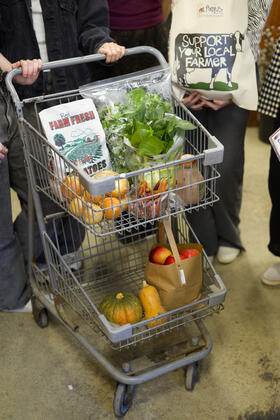
Some 1.5 million Michiganders are food insecure, an issue that is exacerbated in rural communities, where transportation barriers and a lack of grocery stores make accessing fresh food more difficult. And with cuts to staffing and funding, food assistance organizations throughout the state are being asked to do more with less.
Cassie Chen, Louise Depa, Selina Lu, Alexandra Schweid and Victoria Sung wanted to reduce this burden. For their semester-long project in SI 500: People, Information and Problem-Solving, they worked as a team to investigate rural food insecurity and design a solution.
The students began by interviewing experts: food system leaders, researchers, farmers and community organizations across Michigan.
“These are problems that they have to face every day,” Sung says.
All Master of Science in Information and Master of Health Informatics students take SI 500 in their first term. The course prepares them to become human-centered problem-solvers — professionals who can identify a problem, communicate with stakeholders and use technology strategically to design solutions.
Students partner with real organizations while collaborating across programs and pathways, bringing together expertise in areas like user experience research, data analysis, library and information science, and health informatics.
Working with their client, NTCA–The Rural Broadband Association, the team proposed an AI-powered platform that could connect rural residents with food assistance resources. By bringing up-to-date information together in a single location and automating some administrative tasks, the platform would help organizations serve more people with fewer resources.

The team says this is the next level of problem solving you get to do in graduate school — you aren’t coming in with a brilliant solution no one has ever thought of before. Instead, you’re speaking with people who have spent decades working on solutions and then asking, How can we make that more effective, or ensure people know about it?
“Working with a real client who is actually doing important work in the community, I thought it felt a lot more impactful compared to a hypothetical scenario,” Depa says. “It felt a lot more real because it is.”
LEARN MORE
Could your organization benefit from solutions like this? UMSI is seeking organizations with projects related to human health and well-being to serve as fall 2026 clients for SI 500, at no cost. Submit a project idea.