
MADS students and faculty build thriving online community

Tuesday, 04/12/2022
By Martha SpallWhen Matt Wiese was considering the online Master of Applied Data Science program at the University of Michigan School of Information, he had one major concern.
“Considering the program is entirely online, how would we connect with faculty? Would there be enough communication?”
What Wiese found as a MADS student, though, is a robust community of faculty and students who chat online, meet up in person and support each other through the entire program and beyond.
“Everyone is so friendly and willing to help,” Wiese says. “I’m continually surprised with how engaged the faculty are. They truly love the program and the interactions they have with students, and it shows.”
Senior recruiting and admissions coordinator Kelly Barger, one of the first points of contact at UMSI for folks interested in pursuing MADS, reassures potential applicants that a supportive community is waiting to welcome them in.
“You’ll be joining a prolific network of data scientists influencing the future of the field, with access to online discussion groups that are interest- and identity-driven,” Barger says. “Of course, MADS students also have access to all U-M and UMSI community resources, including strategic career resources through UMSI’s Career Development Office and opportunities to gain hands-on experience through our Engaged Learning Office.”
With 669 students and 150 instructors as of winter 2022, the program boasts a 4.5 to one student-instructor ratio, which compares favorably to the national average ratio of 14 to one. Thirty-seven instructors have an especially rich understanding of MADS student needs because they are or were UMSI MADS students themselves.
MADS centers what MOOCs miss: student/faculty engagement
Assistant professor Christopher Brooks is part of a team of UMSI faculty who launched a five-course series on applied data science with Python on Coursera in 2017. The massive open online courses (MOOCs) were in such high demand, UMSI began developing the MADS degree to help data science students put data to work across a wide breadth of industries and organizations for human good.
Brooks and colleagues designed the degree to put student/faculty engagement at the forefront, something that MOOC students miss.
“Due to the number of students in the MOOC courses, they really only have one another and part-time support staff to address questions,” Brooks says.
“But for every new cohort in MADS I remind them that one-on-one meetings with myself and the other faculty in the school are part of the package if they want it,” Brooks says. “Our job is to be here for them, to talk with them not just about course content, but how the degree fits into their own career aspirations whether it's growing with a company they are already with or pivoting into a new role.”
Beyond that, Brooks says technical MOOCs don’t often dive into the deep social science aspects covered in the MADS curriculum, important things like communication and ethics that are increasingly sought after in the job market.
Students build a peer network and access support online
The Slack communication platform provides MADS students with around-the-clock access to other students for collaboration and help with coursework.
There’s almost always someone online to help. Slack also affords students opportunities to form groups around similar interests and identities and arrange meetups with peers in their area.
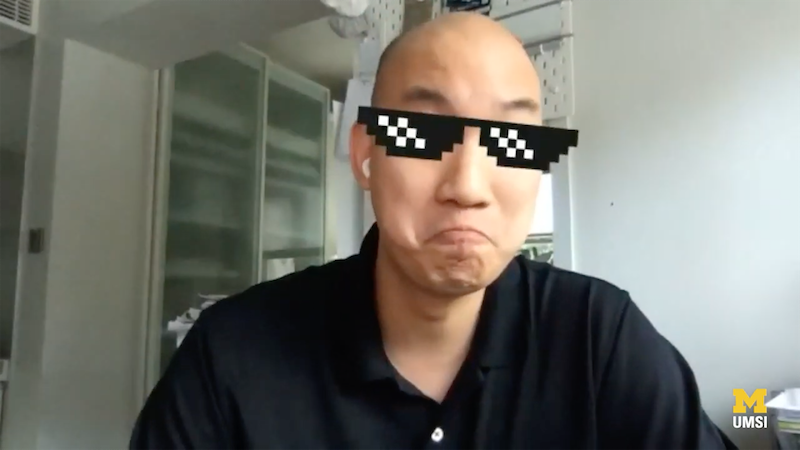
It’s just one of the tools that students like Tim Chen, a Hong Kong-based IT development manager, use to propel themselves to success in the MADS program.
Chen decided to study data science after the artificial intelligence startup where he was working downsized and he realized he needed to diversify his skills. After coming across a Reddit discussion about UMSI’s MADS degree program and comparing it against other, more local programs, he decided there were greater advantages in learning remotely through UMSI.
“Rather than gauge the program solely on its content, I made my decision based more on which institution had the faculty and students I would most like to connect with,” he says. “And it turns out engaging for me was a lot easier online through Slack and Zoom than it is in person, so I was actually a lot more involved.”
Chen, who comes from a programming background, earned a reputation as an active peer mentor on Slack. The MADS community cheered as he took the virtual stage as a student speaker at the online event celebrating the first cohort of MADS graduates in 2021. Chen highlighted some of the experiences he was able to cultivate because of MADS including leading an oral presentation at a scientific conference and negotiating a data-centric management role.
Students’ interests and feedback evolve MADS in real time
Communication between faculty and students is one of the greatest strengths of the MADS community. MADS students have shown they are willing to share feedback with faculty, and faculty are eager to hear them and adjust as needed.
“I want the MADS program to be the best data science master’s program in the country,” says student Daniel Best, president of the Master of Applied Data Science Association (MADSA), the UMSI organization for students in the program. When he wanted to give feedback to UMSI after his first semester, he helped establish MADSA to enhance communication between MADS students, UMSI and U-M.
“MADSA taps into the diverse background and strengths of the student body in MADS,” says Brooks. “It’s helping the faculty meet students where they are and support an excellent educational experience.”
All MADS students are automatically members of MADSA. They’re welcome to the organization’s recurring coffee chats, where students are randomly paired with peers over Zoom to get to know each other.
In-person MADS meetups have also taken off across the globe, from the Bay Area to Singapore.
“I have a classmate who lives 20 minutes from me, and we’ve arranged a couple meetups so far,” says MADS student Stacey Beck. “The world feels a lot smaller, suddenly.”
Brillie Phan, MADSA’s experiential learning officer, says that bringing that face-to-face feeling online is an important part of fostering community within the program.

“In the MADSA coffee chats, we try to match people across cohorts and time zones,” she says. “Having these conversations allows us to open up about our goals, careers and challenges, and it gives us a sense of community.”
MADSA recently held its first academic town hall, where almost 90 MADS students, faculty and staff came together for constructive dialogue.
“I was told this was one of the best-attended UMSI academic program town halls, and I can’t say I’m surprised,” says Amy Homkes-Hayes, associate director of online programs and strategic advisor to the leadership team on online programs and digital content. “Our community is deeply invested. I appreciate the transparent feedback we received, and we have several actionable takeaways based on what students shared to improve MADS courses and their experiences in our program.
“The MADS community and its members show up for each other in so many ways, large and small,” says Homkes-Hayes. “From impromptu in-person gatherings to recommendations on tools to use for data science projects, I am both impressed and humbled by how supportive and engaged folks are.”
Learn more about UMSI’s fully online Master of Applied Data Science program and how to apply.