
Meet Dallas Card: New assistant professor for UMSI

Monday, 01/03/2022
Computer scientist Dallas Card joined the University of Michigan School of Information as an assistant professor in January 2022. Card’s research focuses on how to make machine learning more reliable and responsible, and how to gather societal insights from historical text records.
Hailing from Toronto, Canada, Card has lived in the United States since his graduate school days at Carnegie Mellon University. With a background in engineering, international development, machine learning, and computer science, Card brings his wealth of experience to UMSI.
Card and UMSI’s Sarah Derouin chatted about interdisciplinary collaboration, what is “good” science, and how long distance biking can reveal unexpected information about the world.
How did you make your way to information science?
I have a complicated academic history in some sense. I started off in a program called System Design Engineering at the University of Waterloo, which was an unusual program — it was very much a core engineering program, but it emphasized trying to understand components of systems, break them down into pieces, and find interesting commonalities among the electromechanical and social systems. It was a great foundation for a lot of things.
At the time, I didn't necessarily feel like the jobs that were being taken by my colleagues were that interesting. I ended up doing a master's in international development studies where I spent a lot of time being more of a social scientist.
After graduating, I ended up back in Toronto, working in research at the Hospital for Sick Children. I worked for a psychologist who used MRI and EEG as her main research tools to study child development, especially developmental disorders. It was not something that I had a strong background in, but this job was a jack-of-all-trades role where I helped with the technical side of various things related to MRI.
My time at the hospital exposed me to working with large datasets and statistical analysis of complex data. It also gave me the chance to work with a bunch of people in an interdisciplinary research environment, including doctors and physicists. At that point, it was clear to me that I wanted to be in research.
So you decided to get your doctorate in machine learning. Why did you pick that subject?
I’ve had this pendulum process between the technical and social. Machine learning really felt like the most central discipline that I could be in, in terms of being able to collaborate with a wide range of people. It had this sort of core methodological aspect, but also was clearly connected to issues on the horizon, in terms of decision-making at scale. I was drawn to it because there was this potential for cooperation.
This was somewhat before the major boom in machine learning— it wasn't at all clear at the time that it was going to be quite so hot a field as it ended up becoming. I sort of lucked into that, to be honest.
Tell me about your research interests.
One that is closest to what I've done during my PhD and postdoc, is essentially using machine learning and natural language processing (NLP), to analyze textual corpora (written or spoken words that are recorded), especially historical texts or those related to political issues. The idea is to try to help understand things about people or society by analyzing the text that has been produced along the way. So just as one example my colleagues and I just submitted a paper looking at the history of immigration in the United States (we also presented the work at the 2021 TADA, Analyzing Text as Data Conference). We specifically focused on how it's been discussed in Congress, because Congress provides a really nice sort of consistent record of all the speeches made by political figures over more than 100 years. We're able to use NLP to look at how ideas about immigration have changed, how different emphases have changed, and so forth.
Second major part is thinking about science more generally. This involves technical questions about research in machine learning around things like reproducibility, and whether or not results are reliable. This past year I looked at how people in machine learning present their work and what aspects they emphasize as being valuable as a way to understand the implicit sort of values in the field.
Lastly, I’ve been thinking about how this technology is being applied in the real world, which, of course, immediately runs into much more complicated issues of how to interact with people and so forth. I think there's both a combination of sort of technical and social questions here, with the technical being things like: how do we communicate uncertainty? How do we know when a system is reliable? And the social being: how do people actually incorporate this information into their own decision making system?
You've mentioned reproducibility a couple times— why is that so important to you as a scientist?
It's very interesting to think about what science actually is. I think we have this image of lone people working on their own and coming up with brilliant ideas and revolutionizing fields, but there's tons and tons of people involved in research. And moreover, a lot of what happens is just as important for training as it is for actually producing knowledge.
The big picture should be that we want the work people are doing to be as useful as possible to the broader community. In many fields, there’s been a lot of issues around failing to replicate, of using sample sizes that are too small, or many people pursuing the same question. So, I think reproducibility is one way of looking at these issues, but it also connects to things like transparency and openness. So I am a huge proponent of trying to make all the products of scientific research as accessible as possible— the actual papers we publish, which should hopefully be ideally available to everyone, but also the code used to produce the results and clarity about exactly what was done.
Tell me something unexpected about you.
I’ve long been a fan of long-distance cycling. A number of years ago, a friend of mine got me into this. It's kind of amazing how you can go for a really long time on a bicycle, to the point where we do these multi-day bicycle trips.
The most interesting one was when we rode a trail that goes from Pittsburgh to Washington, D.C. It's a fantastic trail. One of the coolest things about it is, somehow the distance you can go on a bicycle in a day feels comparable to what distances might have been like before automobiles. When you're riding across the country, towns seem to be almost spaced at the perfect distances somehow.
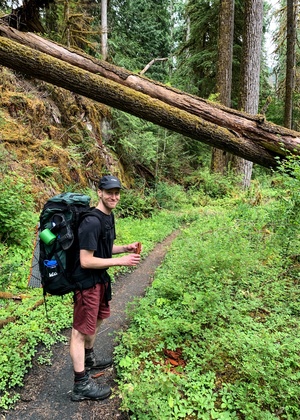
I just love to travel and see all parts of the world. And anytime you find an unexpected insight into how things used to be, to get a different perspective on how things are now, it's just my favorite thing.
Why is UMSI a good fit for you?
I think in some ways, it's a perfect fit. I'm interested in collaborative work across many disciplines— I can't think of many other places that have such a concentration of people from diverse academic backgrounds in one department. So that in itself is by far the most attractive feature of being at UMSI.
It also seems like the kind of education that UMSI is providing is particularly relevant to the next generation. I think there's a risk in more traditional computer science departments, where people only learn the technical side without thinking about the broader implications. We're helping people understand how to work with data in a technical capacity, but also see the bigger picture.
Learn more about Assistant Professor Dallas Card’s research into anti-immigration from his talk at the 2021 TADA (New Directions in Analyzing Text as Data) conference presentation.