
UMSI alumna Carolann Decasiano is using data to help employees thrive

Friday, 01/16/2026
By Martha SpallCarolann Decasiano is part of a growing group of data scientists applying modern analytics to one of the most people-centered fields: human resources.
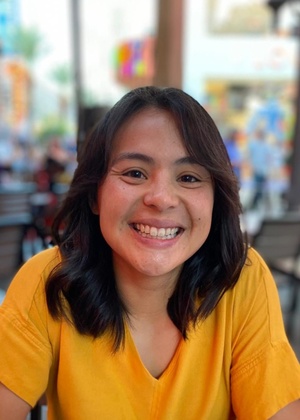
While working full time as a human resources information systems and data analyst at the California Institute of Technology, Decasiano enrolled in the University of Michigan School of Information’s online Master of Applied Data Science program. Her goal was simple and practical: to build technical skills in the classroom — then apply them directly to her work.
Entering the MADS program with experience in Excel but little exposure to programming, Decasiano learned tools like Python and SQL while also developing an ethical approach to working with sensitive HR data. In just two years, she went from what she describes as “very basic analytics experience” to earning a U-M master’s degree in data science, prepared to contribute to the evolving field of HR analytics.
“Companies can utilize information systems to make their workforce better, to make it more enjoyable to do your job,” Decasiano says. “You spend 40 hours per week there. The hope is that an employer will help make that time enjoyable.”
In the Q&A below, Decasiano reflects on the most valuable aspects of her MADS experience and offers advice for those looking to break into the information workforce.
UMSI: Why did you choose to pursue UMSI’s fully online Master of Applied Data Science degree program?
Carolann Decasiano: I decided on MADS because it just had much more flexibility around my full-time work. I wanted to stay working throughout my graduate career because I’ve never left the workforce since I started working. MADS had the most flexibility around my current career.
The program itself had a lot of courses and resources that were very relevant to what I wanted to do within my domain, which is human resources — so people analytics. The idea was to take all of the data science from the MADS courses and apply it to my domain.
What do you do in your current role? How are you applying your MADS skills?
Different companies have different data maturity when it comes to human resources. My workplace, Caltech, is young in our data maturity in regards to HR. We’re at the information gathering stage — not yet summarizing it, using it for predictive analytics, or the next highest level: using it for machine learning or anything like that.
So the idea was for me to learn the practical skills of Python coding, SQL databases, infrastructure … and in human resources there are ethical implications, and MADS also has a course on data ethics, which is very helpful for my dealing with people in my domain. We’re dealing with people’s information. I was immediately able to apply courses like that to my current position. That’s what my goal was.
In HR right now, I fundamentally do people analytics, essentially trying to gain insight on the people information that we have: people’s job classifications, salaries, any adverse impact of hiring and employment practices on the workforce.
What does a day in your life look like?
A lot of my day-to-day as a senior HR data analyst typically involves putting out fires, meaning people are reaching out to me and asking for a data extract, or summarizing information. That’s a big part of my day.
The other part of my day is project work, building visuals around our workforce, creating dashboards. I use some tools like Power BI to create dashboards to share with executives, department managers and even HR business partners. I also do ETL to move raw data from our various sources into these dashboards. That’s a big part of my day too. If you’re familiar with any data scientist or data analyst, 90% of the job is just cleaning the data.
Did you have any data analysis experience prior to joining MADS?
I had very basic analytics experience trying to determine KPIs for HR data and workforce data. Nothing where I was ever trying to gain insights or make predictions — more just summarizing.
The only data tool I ever used before MADS was Excel. Before all of the learning I did in the MADS program, I just did manual manipulation in Excel files using the formulas provided, which did provide fundamental analytics. However, I needed stronger tools like Python, and I needed to learn how to do API calls and to read and extract information most efficiently.
What was your most valuable UMSI experience?
I think the Milestone and Capstone projects in MADS were especially valuable. The Milestones really helped me understand the data science process: where to even start with exploratory data analysis, then moving into the machine learning phases. Our final Capstone really put the whole program together in a real-world context.
I think that was the most valuable experience I’ve taken out of the program, because with my Capstone I did something that was very relevant to my current work. I used data sets that IBM released a long time ago, employee data related to attrition — in other words, variables that can help predict who’s going to leave a company. I can apply that same model to my current data set.
It’s surprising to hear that HR has so much focus on data.
There’s a whole field now of HR analytics and people data scientists. It’s a growing field within the domain, and all of our employee data is in a system now. Workday is one of the biggest ones. Oracle has HR information systems. Then there’s smaller ones, like Greenhouse and ADP. Companies can utilize these systems to make their workforce better, to make it more enjoyable to do your job. You spend 40 hours per week there. The hope is that an employer will help make that time enjoyable.
How did you start on your career path?
During my undergraduate years, I needed to earn my own money to pay for school. I got a job as an HR clerk in the town over. As an HR clerk, I was literally in a room with no windows, looking at and organizing paper files. This was back in 2009 or 2010. I did that throughout all of undergrad, and once I graduated I was able to move into an HR specialist role and then a generalist role, because of that work experience. Then, because I had a knack for data and analytics, I made the transition to HR systems and data.
Would you like to share one piece of advice for undergraduates and new graduates trying to enter and keep up with the information field?
Sign up for publications and have them fall into your inbox — and read them. See what’s interesting. Use Medium to find self-published articles that people put out.
Join local organizations. For example, I’m part of the LGBT community, and there’s an organization called Lesbians Who Tech. They host events across the U.S. I applied to be part of their leadership program and was accepted. Looking for organizations and affinity groups like that is an amazing way to keep up with current trends in information science.
What would you tell yourself before you joined MADS?
Information science is a massive field. It’s huge, and it’s only increasing. It can be overwhelming. You might not know where to start or how to absorb your courses, but it’s alright. You’re good. You’ll find your rhythm. Do what works best for you, and take it one piece at a time.
LEARN MORE