
Book Launch: Algorithmic Realism with Assistant Professor Ben Green

Register to Attend on Zoom Here.
Save the Date!
ESC will be hosting a book launch with UMSI Professor Ben Green to talk about his new book, Algorithmic Realism: Data Science Practices to Promote Social Justice on Tuesday, November 3rd from 3 – 4:00 pm in the Leinweber Building’s Dow Room 4320 (or Online via Zoom).
Join us to hear Prof. Green in conversation with UMSI Professor Abigail Jacobs and CSE Professor Benjamin Kuipers. Light snacks and refreshments will be provided.
Please register for in-person attendance here, or register here if you plan to attend online.
This book launch is co-sponsored by The Center for Ethics, Society, and Computing (ESC), and the Michigan Institute for Data & AI in Society (MIDAS).
Book Description for Algorithmic Realism
A bold new vision for data science—and a practical, step-by-step guide for how data scientists can contribute to social justice.
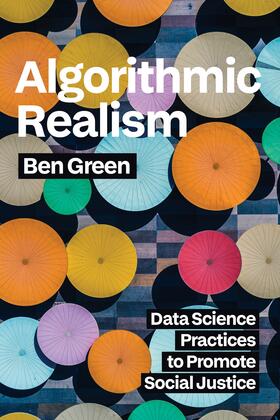
The field of data science faces a moral crisis. Despite the desires of data scientists to develop algorithms for good, algorithms regularly produce injustice in practice. Given these persistent harms, the field must reflect on difficult questions about its identity and future. Can data science be a force for promoting social justice in the world? What practices should data scientists follow to achieve this goal?
In Algorithmic Realism, Ben Green presents a bold and interdisciplinary approach to data science. Drawing on his experience practicing data science in the public interest, he argues that improving society with algorithms requires transforming data science from a formalist methodology focused on mathematical models into a practical methodology focused on addressing real-world problems. By providing an expanded framework for the “data science workflow”—the steps that characterize the algorithm-development process—he offers a practical, step-by-step guide describing how data scientists can apply their skills in service of social justice. Through these contributions, the book reveals a vision for a renewed, but realistic, optimism about data science’s potential to foster a more equitable world.
About ESC
The Center for Ethics, Society, and Computing (ESC – pronounced “escape”) is dedicated to intervening when digital media and computing technologies reproduce inequality, exclusion, corruption, deception, racism, or sexism. ESC is generously supported by the School of Information; the Center for Political Studies at the Institute for Social Research; and the Department of Communication & Media in the College of Literature, Science, and the Arts at the University of Michigan.
Learn more about the event on ESC's website.
Featured Speaker

Ben Green
Assistant Professor of Information and Public Policy
University of Michigan
Ben Green is an Assistant Professor of Information and Public Policy at the University of Michigan and a Faculty Associate at the Berkman Klein Center for Internet & Society at Harvard. Through his research, writing, and advocacy, Ben contributes practical lessons for achieving a world in which AI improves society rather than exacerbating inequality and oppression. He has published op-eds in outlets including The New York Times, The Wall Street Journal, and The Hill, and has been quoted in newspapers such as The New York Times, The Washington Post, and the Los Angeles Times. He is the author of two books from the MIT Press: Algorithmic Realism: Data Science Practices to Promote Social Justice (2026) and The Smart Enough City: Putting Technology in Its Place to Reclaim Our Urban Future (2019).
RSVP for In-Person Attendance Here.
Contact: [email protected]