
‘Archival intelligence’: A retrospective on retiring faculty member Elizabeth Yakel

Tuesday, 05/27/2025
By Abigail McFeeAs breakthroughs were being made in artificial intelligence in the early 2000s, Elizabeth Yakel wrote about a different kind of “AI”: archival intelligence.
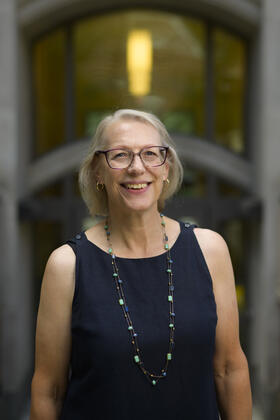
Yakel was one of the first scholars in her field to consider the archive from the user’s perspective, identifying the forms of knowledge an individual needs to approach and successfully navigate archival collections. Throughout her distinguished career as a researcher, educator and administrator, she has worked to advance archival practice and education.
A two-time alumna and long-time faculty member at the University of Michigan School of Information, Yakel holds the title of C. Olivia Frost Collegiate Professor of Information. She served as interim dean from August 2022 to January 2024, when she was succeeded by Dean Andrea Forte.
Receptiveness and rigor — hallmarks of her scholarship — characterize her leadership of the school and the legacy she leaves with colleagues and students. Yakel will retire this June, concluding a 25-year chapter at UMSI that has shaped the school’s direction and the archival field more broadly.
Back to the source
As an undergraduate English major at Brown University, where she worked in the John Hay Library, Yakel enrolled in a course on historical archives. “It seemed to combine my love of history with my love of libraries,” she said.
Each student was assigned an archival collection to analyze and interpret. Yakel worked with the collection of Sarah Helen Whitman, a prominent 19th century Providence poet and transcendentalist. Whitman’s portrait hangs in the Providence Athenaeum, a historic library in College Hill. She frequented the Athenaeum during her lifetime, cultivating a community of writers, thinkers and artists that included Edgar Allen Poe.

“I could go see the portrait as I was going through her materials,” Yakel said. “I really, with my first hands-on experience with primary sources, got hooked.”
Part of the allure of primary sources is their immediacy. Letters, artifacts, journals and recordings bring researchers and learners into close contact with the past, including profoundly personal material. Throughout her career, Yakel has advocated for the use of primary sources in education.
Committed to pursuing further studies in the archives, she moved to Ann Arbor, Michigan, in 1980 to earn her Master of Arts in Library Science at the U-M School of Library and Information Studies.
The school differed in many respects from the present-day School of Information — in name, size and programs offered — but Yakel experienced a curricular philosophy she recognizes in UMSI’s current emphasis on engaged learning.
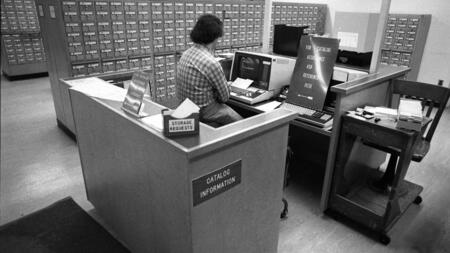
“You’re doing what you're learning about in courses,” she reflected. “I was applying it and seeing where the theory ends and where practice begins.”
At that time, each residence hall had its own librarian, a title Yakel held in Alice Lloyd Hall. She also worked at the reference desk in Harlan Hatcher Graduate Library. Her favorite part of the job was never knowing what question she was going to be asked next.
A shared mission
Yakel went on to earn her doctoral degree in 1997 from the University of Michigan School of Information, which the year prior had taken on a new name and mission: “to prepare socially engaged information professionals and to create people-centered knowledge, systems and institutions for the information age.”
She saw this evolution firsthand as a doctoral student and, later, as faculty. After teaching at the University of Pittsburgh for three years, she returned to UMSI as an assistant professor in July 2000. She was promoted to associate professor, with tenure, in 2005 and to professor in 2011.
“The rechartering of UMSI in the 1990s brought together an interdisciplinary group of people, and that interdisciplinarity has expanded over the years,” she said. “The reach to different disciplines has also grown.”
Yakel has served the school in a number of capacities. She was appointed as associate dean for research and faculty affairs in 2014, then senior associate dean for academic affairs in 2015. In 2021, she was appointed as the C. Olivia Frost Collegiate Professor of Information. She has developed five graduate-level courses at UMSI, including “Digital Preservation” and “Research Methods for Information Professionals.”
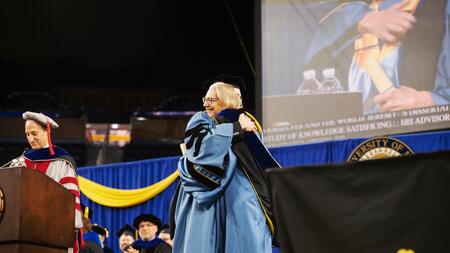
As a faculty member, Yakel has had a profound impact on her students, many of whom have gone on to pursue notable careers.
“It’s really exciting to see former students starting to take leadership roles in different organizations,” she said.
Libby Hemphill, associate professor of information, worked with Yakel as a graduate student and returned to UMSI as faculty in 2017. She is widely recognized for her expertise in digital curation, social media and civic engagement.
“Getting a chance to work with Beth again was one of the main reasons I returned to UMSI,” Hemphill said. “She is a legend in archives and data reuse, and I've been incredibly grateful for her guidance as I build my archival expertise.”
Contributions to scholarship
Part investigator, part interpreter, Yakel endeavors across her scholarly writing to facilitate a deeper understanding of users’ needs and to integrate insights from disparate academic disciplines. Her work underscores that primary sources and digital data are only as useful as they are usable.
“I was someone who really spearheaded trying to get people not to look at archives from the system's perspective, but more from the user's perspective — and what impeded use,” Yakel said.
In 2002, with assistance from UMSI doctoral student Deborah A. Torres, Yakel undertook a study of 30 archival researchers — historians, sociologists, anthropologists and education researchers — based on qualitative interviews and hundreds of hours of observation. She coined the term “archival intelligence” to describe the skills and knowledge needed by users of archives.
The article that resulted, “AI: Archival Intelligence and User Expertise” (2003), is one of Yakel’s most cited publications. Her work emphasizes understanding the needs, expectations and behaviors of diverse user communities to improve access to archival materials.
She has published numerous peer-reviewed articles, and she served as an editor of the leading journal in her field, Archival Science, until 2023.
For me, Beth modeled what it means to appreciate the field's historical legacy while also embracing the future and exploring new directions.
“I would describe her approach as hands-on and curious, which I think is evident in the breadth of her research output,” said Dharma Akmon, managing director of U-M’s Institute for Research on Innovation and Science. Akmon worked with Yakel on multiple research projects as a master’s and doctoral student at UMSI. “For me, Beth modeled what it means to appreciate the field's historical legacy while also embracing the future and exploring new directions. She opened my mind to what was possible in this field.”
Yakel’s recent research focuses on data reuse — taking existing data that has been compiled by individuals and institutions and using it for a new research purpose.
”The same thing I was doing 20 years ago with archives and physical data, now I’m thinking about with digital data,” she said. Her research considers how users make sense of data, the standards within different academic disciplines, and what format makes data most accessible.
“Data reuse” might sound abstract, but many applications are tangible. For example, Yakel has worked extensively with archaeologists and zooarchaeologists, who use quantitative data like tooth length and density to identify whether bones belonged to a wild or domesticated animal — which can present information, in turn, about when civilizations emerged in a particular region.
“But archaeologists are very site specific,” Yakel said. “So you don't get a sense of how cultures emerge over time or geographically,” unless data is shared across archaeological sites.
Yakel sees this kind of collaboration — both within and across academic disciplines — as essential not only to academia but to the public sphere.
“The federal government spends billions of dollars on research every year, and much of that research data just lies fallow on computers or in people's desk drawers,” Yakel said. “What I want to better understand is how we can facilitate more data sharing and reuse.”
Leadership and legacy
During her 16-month tenure as interim dean, Yakel guided the school through a period of growth while honoring its roots.
In 2022, UMSI celebrated the groundbreaking of the Leinweber Computer Science and Information Building, which opened its doors earlier this month.
UMSI’s operations and graduate programs are now housed alongside the Computer Science and Engineering Division of Michigan Engineering.
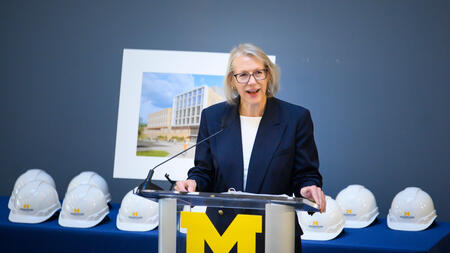
“This is our chance to build an environment that enhances student learning … and exciting collaborations with CSE students, so we can fully realize the innovative pedagogies we are now instilling in our curriculum,” Yakel said at the groundbreaking ceremony.
The expansion of the school goes beyond steel and concrete — UMSI’s undergraduate and graduate programs, including its online Master of Applied Data Science, have grown rapidly in the past 5 to 10 years. As interim dean, Yakel recognized the need to increase support for staff and faculty in tandem with the expansion of the MADS program and new curricular offerings.
Under her leadership, UMSI created 15 new staff positions and hired six core faculty members. Yakel set up one-on-one meetings to welcome every new member of staff and faculty.
“I highly value traits such as open communication, support and transparency in a leader, and Beth has exemplified each of these qualities numerous times,” said Judan Flanagan, associate director of human resources at UMSI. “It's evident that she genuinely cares about the UMSI community.”
Yake’s tenure as interim dean also saw an expansion of graduate degree funding. In December 2022, UMSI announced it would offer free graduate school tuition in two programs for full-time students who were awarded the U-M Go Blue Guarantee grant as undergraduates. In doing so, it became the first U-M school or college to extend the Go Blue Guarantee into a graduate guarantee.
During this time, UMSI continued to adapt its curriculum to reflect changes in society — including novel AI approaches and automotive UX — while embracing areas of research that have the greatest real-world impact.
One of the accomplishments Yakel is most proud of is continuing to strengthen teaching practices. “Because I was senior associate dean for academic affairs for so long, as interim dean I tried to build more scaffolding around teaching,” she said. “I think that’s really important and a core part of our mission.”
This past March, Yakel led an Alternative Spring Break trip to Yellowstone National Park, where a team of master’s students embarked on an archives blitz funded by a grant from the National Park Service. The team’s work, which amounted to 80 boxes of processed records, made the history of Yellowstone’s resources more accessible to researchers, ecologists and the public.
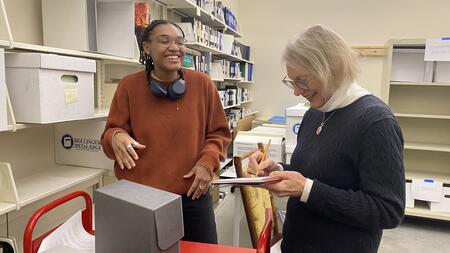
From the beginning, Yakel made it clear to the students that she wasn’t on the trip as their authority — she was there alongside them, experiencing this collection for the first time.
“That helped empower us to be archivists, rather than just students on a trip,” said MSI student Nadiri Saunders.
Yakel’s hope for the future of UMSI is that “it continues to foster really excellent teaching, excellent research and interesting scholarship.”
And for future students of the archives, “My hope is that they question everything,” she said. “It’s a combination of being very keyed in on what is excellent archival work, yet questioning the canon.”
UMSI will celebrate Yakel’s contributions to the field with a symposium held on June 5 and 6, “Archival Representation(s): Honoring Elizabeth Yakel,” organized by associate professor of information Ricky Punzalan and assistant professor of information Rebecca D. Frank. A retirement reception, open to the UMSI community, will follow on June 6.