
From the archives: UMSI’s first graduate

Thursday, 10/01/2026
By Eli McClain
My path crossed with the University of Michigan School of Information's 100 years after its founding. I was given the opportunity to work as a centennial research assistant, piecing together the school's history through archival research at the Bentley Historical Library.
Over the course of two months, I spent countless hours sorting through portions of UMSI’s 54.5 linear feet of archival materials (57 boxes) dating back to 1904. I worked to uncover new stories from the school’s past and the experiences of its students, faculty, staff and alumni.
Patterns across time
From my first job at a local public library, to pursuing archival research on the development of cultural heritage collections in the U.S. and UK, to working with more than 100 museums and libraries across New York to tell new and diverse stories from their collections during the COVID-19 pandemic, libraries and archives have played a vital role in my academic and professional trajectory.

In reading through the school’s records, there is an intimacy you feel when coming across the little touches that provide insights into someone’s personality. There is a notable care in the writings and in the attempts to weather storms, to identify creative solutions to external economic and social pressures over the ages and to celebrate the achievements of students and faculty alike.
While some things have changed considerably since the department’s creation in 1926 (comparing the department’s first space in the General Library to the school’s present-day home in the Leinweber Building would not be fair), many patterns appear over and over again throughout the school’s history.
Continued challenges of funding, enrollment, changing technology and curriculum, and the role of librarians and information professionals in society are present across time, despite taking different forms. As Abigail McFee expressed precisely, the school has worked to balance future and current needs, outgrowing its name time and time again as the way information is stored and utilized has evolved.
While there are many stories that can be told to illustrate the school’s history, I want to look back at one of the thousands of alumni who took what they learned at U-M and applied it to improve the world of information around them.
How a high school teacher helped organize the nation
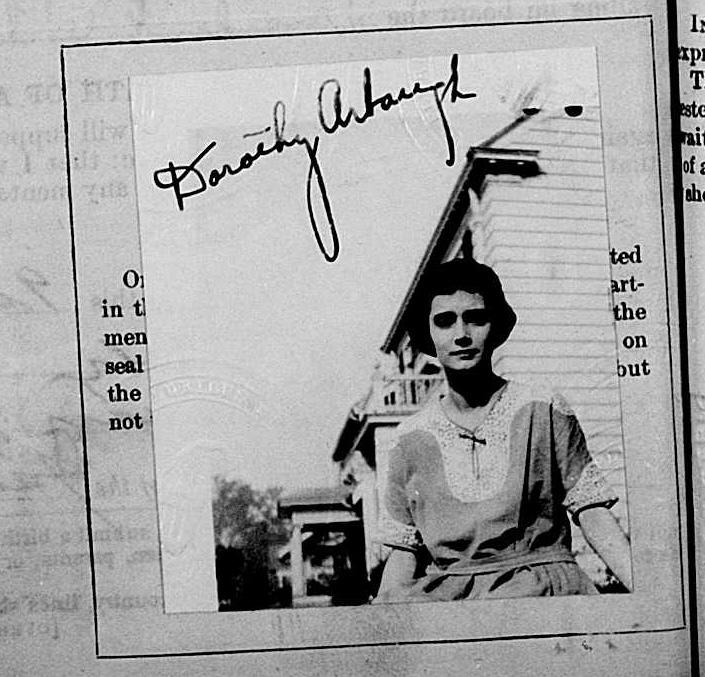
Dorothy Arbaugh had the privilege of being called the department’s first ABLS graduate in 1927, thanks to coming first alphabetically in her graduating class.
She enrolled in the Department of Library Science’s first class in 1926, leaving her job as an English teacher at Ann Arbor High School. After learning from one of the era’s leading catalogers, Margaret Mann, who was recruited by department chair W.W. Bishop to join the faculty, Dorothy embarked on a cataloging career of her own.
She moved to Iowa after graduation, where she worked at Iowa State University until 1930, when she returned to Ann Arbor to pursue her master’s degree in the department. She then spent five years in Indiana at the State Teachers College in Terre Haute before moving to Washington, D.C., to begin a long career in federal service.
Dorothy joined the cataloging staff of the National Archives just two years after it was established. In D.C., she cataloged not only books, papers, statistics, maps and photographs, but also an expanding collection of motion picture films.
During World War II, she was appointed assistant director of libraries for the War Department in the Office of the Quartermaster General. Librarians around the world were tapped during the war to staff army libraries and contribute to intelligence efforts. Their skills in organizing and accessing information efficiently, and in responding to complex queries, made them well-suited to war efforts, where accurate and up-to-date information was paramount.
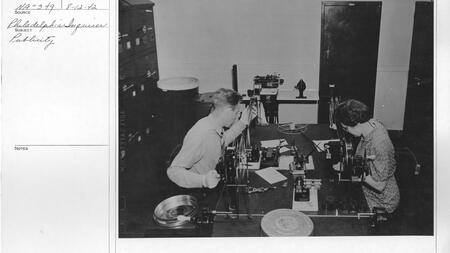
She also conducted training courses on new cataloging rules and procedures for staff across the U.S. Copyright Office. In the post-war period, Dorothy returned to D.C., heading the office’s book division. She remained at the U.S. Copyright Office until her retirement in 1966, having risen to the rank of specialist in copyright records utilization and received a pin for 30 years of service.
In September 1972, Dorothy passed away in D.C., and the following spring Dean Russel Bidlack wrote to the alumni body alerting them of her death and commending her career of service to the field.
Dorothy marked the start of 100 years of information graduates. Her story, pieced together through the archives and federal records, reminds us that UMSI's century-long history has played out far beyond the walls of the institution. Its first graduate, like graduates today, contributed to her communities at the local, national and international levels. She took what she learned here and put it to work for the world.
ACKNOWLEDGEMENTS
In addition to UMSI’s collection at the Bentley Historical Library, I reviewed materials from other collections at the Bentley and the Hatcher Library Special Collections, along with digitized materials from the Ann Arbor District Library, National Archives, League of Nations and Vatican Library, among other repositories. I benefitted from conversations with UMSI staff and the school’s former deans, and am grateful for the assistance of the Bentley’s reference staff in locating and accessing materials to tell these stories.