
At MIT Hacking Medicine GrandHack, UMSI students show what health informatics can do

Wednesday, 04/29/2026
By Martha SpallTwo Master of Health Informatics students put their training to the test at the MIT Hacking Medicine GrandHack. Their experiences say everything about what the MHI program prepares students to do in healthcare.
Graciela Lagraba and Simranjeet Singh joined fields of engineers, physicians, entrepreneurs and researchers at GrandHack 2026 in Boston — a three-day innovation event with a singular mission: bring the brightest minds together to build better healthcare. Participants spent the weekend collaborating across disciplines, pressure-testing ideas with mentors and pitching solutions to expert judges.
Both students arrived ready to apply their health informatics foundation, and they left proving that the way UMSI trains students to think is an advantage in high-stakes, real-world environments.
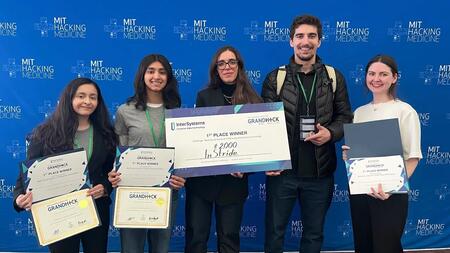
Lagraba’s team tackled a persistent gap in orthopedic rehabilitation. Patients recovering from lower-extremity fractures are prescribed specific weight-bearing limits — but progression is often guided by subjective assessment rather than data. Their solution, InStride, is a monitoring insole that captures continuous gait data, delivering real-time haptic feedback to keep patients within prescribed thresholds and support more data-driven rehabilitation decisions. InStride earned first place in the Intersystems GenAI Challenge and second place in the Trauma and Rehabilitation track.

For Lagraba, the most memorable moment of the weekend came during the final presentation. “One of the judges from Mass General Orthopedics emphasized how impactful our prototype could be,” she says. “Given that we only had three minutes to pitch everything we built, it was incredibly moving to hear that from someone who is treating patients every day in the exact clinical space we were building for.”
Her UMSI training informed not just InStride’s function, but how the team thought about its future. “My background pushed me to think beyond the prototype itself and focus on how our solution fits into the healthcare system,” Lagraba says. “I spent a lot of time shaping how our solution would integrate into clinical workflows, how it would be reimbursed, and which incentives would drive adoption.”
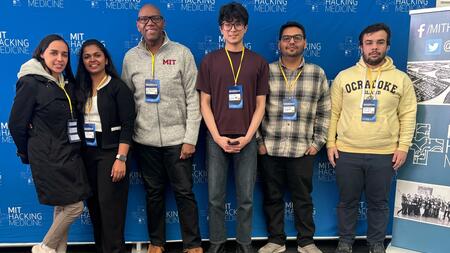
Singh’s team focused on a different but equally pressing challenge: improving access and continuity of care for patients navigating transitions in the healthcare system. Working across disciplines, the team designed a portable, patient-centered solution built around scalable, tech-enabled workflows — identifying key gaps where patients fall through the cracks and building toward something that could realistically close them.
“Seeing our initial rough idea evolve into a structured solution within 48 hours was a very rewarding moment,” Singh reflects. “UMSI has trained me to be comfortable with ambiguity, work across disciplines and iterate quickly — skills that were critical during the hackathon.”
LEARN MORE