
UMSI Design Justice course looks to Detroit for inspiration

Tuesday, 11/18/2025
By Abigail McFee“I came to UMSI for design justice work,” says Maddie House, an accelerated master’s degree student at the University of Michigan School of Information. “I've been talking about the course to everybody who will listen.”
We’re standing in front of Detroit’s Newlab, a collaborative hub for art and prototyping, on a bright day in May. This is a typical class session for Design Justice, a month-long course taught by assistant professor of information Matthew Bui, which combines classroom lectures in Ann Arbor with twice-weekly trips to Detroit, where students explore each week’s theme through direct engagement with the city.
Bui, whose research focuses on the ethical and social dimensions of technology, drew inspiration for the course from Sasha Costanza-Chock’s "Design Justice: Community-Led Practices to Build the Worlds We Need,” a book that describes and advocates for approaches to design that are led by marginalized communities.
“As we’re on this tour, we’re thinking about what innovation is,” Bui tells the group. “But also who typically gets to be part of innovation stories.”
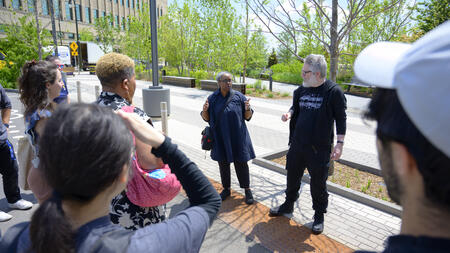
The tour, led by Detroit-based designer, curator and researcher Cézanne Charles and U-M professor of art, design and architecture John Marshall, focuses on four sites of innovation. Charles and Marshall jointly run the Detroit-based design collective rootoftwo.
Students explore Michigan Central, a historic train station that sat abandoned for three decades before being purchased by Ford Motor Company and restored as a global hub for mobility innovation; the adjacent Newlab Detroit; the LOVE Building, a centrally located and accessible home for six nonprofits; and the Museum of Contemporary Art Detroit.

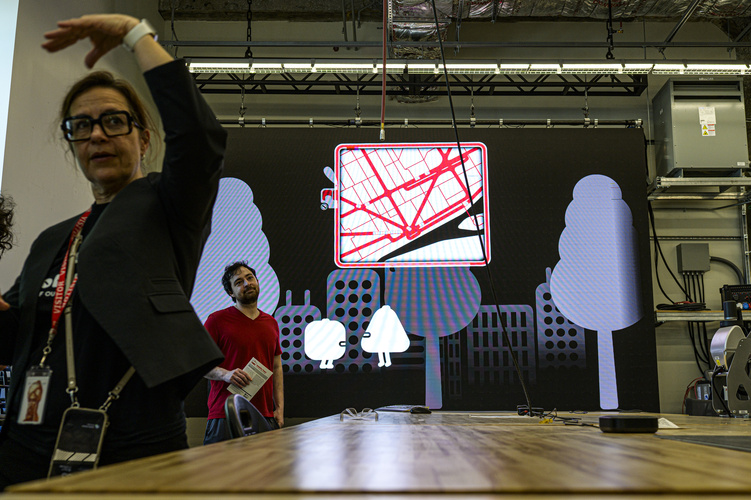
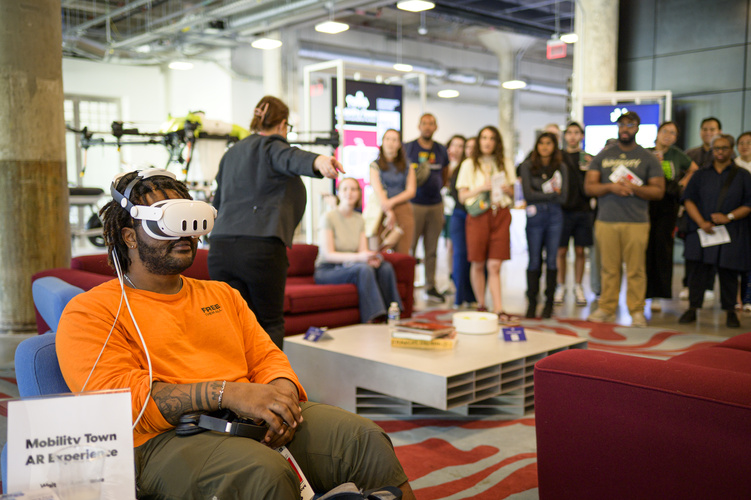
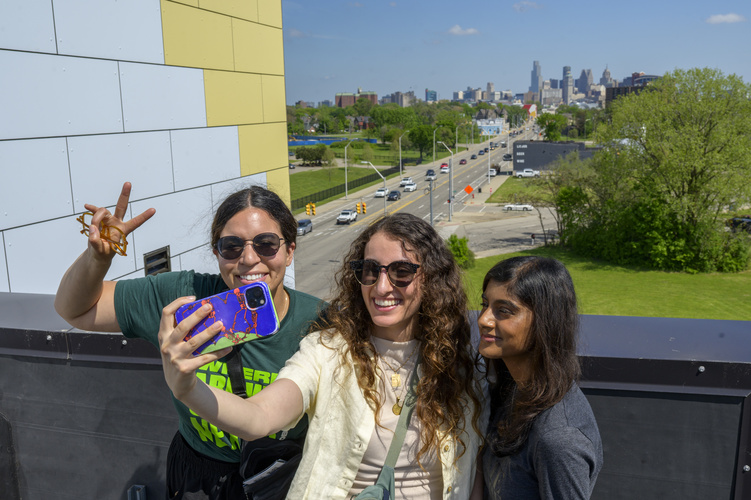

“In a city that was built for far too many people that never moved here, you do want to build amenity-rich communities. You do want to make sure people have access to really world-class education,” Charles says.
But she urges students to consider the ongoing tension between development and displacement: “You can displace people without moving them out of their homes. You can displace them by having them disconnected from the very amenities that you’re bringing in, or creating spaces that don’t feel radically inclusive.”
House listens intently. She came to U-M planning to double major in computer science and women’s and gender studies, but she ended up transferring to UMSI’s Bachelor of Science in Information program, finding it to be the right fit for her interest in socially just technology. Now, as she embarks on her master’s degree at UMSI in user experience research and design, she is deepening that interest.
“I would define design justice as thinking more critically about the ways that our designs affect people,” House says. “How our research and design process either support efforts for justice or amplify unjust systems.”

Her favorite site on the tour was the LOVE Building, where she was struck by the decision to install not one but two elevators in the building’s five-story tower — an enormous monetary investment — to maintain ADA accessibility in case one elevator has mechanical issues.
“I'm really interested in the intersections of technology, design and disability,” says House, who identifies as disabled. “Most of my work has been in digital accessibility, so it was really interesting to see what it looks like when physical accessibility is at the forefront of designing a space.”
For her course project, she focused on improving the process of applying for disability parking placards in Michigan — a project that drew upon her personal experience applying for that accommodation.
This kind of engagement is what Bui hoped for when he designed the course. “It was really encouraging to see students so deeply engaged with the course topic and readings,” he says. “They shared personally and vulnerably about how they were finding the course to be relevant to their design work, inside and outside the class.”
A month is a short time frame, but it allows for an immersive experience: four weeks of deep focus, four weeks to form genuine friendships with classmates while carpooling to and from Detroit.
“One thing I felt the class did really well was challenge the narrative of what Detroit is, what it stands for in its history and what it can be,” says Natalia Rice, a Master of Science in Information student pursuing a dual degree in public policy at the Ford School.
The week after the course ended, she flew to New Orleans for a design justice conference a classmate had told her about during a field trip. She happened to be there when we spoke.
“Because it was mentioned in passing, I got this opportunity,” she says. “I got funded by the university, and now I'm here and I'm able to keep pursuing these interests.”
Rice, who has already built a career as a UX research and designer, is passionate about racial equity and justice. Though the book “Design Justice” aligned perfectly with her interests, she hadn’t heard of it until she signed up for the course.
“That changed everything for me,” she says. “It really highlighted what it means to co-create with a community when you do your work. I realized I had never questioned, am I the right person for this project? Or is there a way for me to facilitate from my position, with the resources I have, while making space for somebody with more lived experience?”
These questions are not simple to answer, Rice acknowledges. But asking them alongside her classmates, who came from a range of disciplines — information science, environmental science and landscape architecture — didn’t make her feel constrained as a designer. It gave her hope for what is possible.
“I really think this should be a required course for everyone,” she says.