
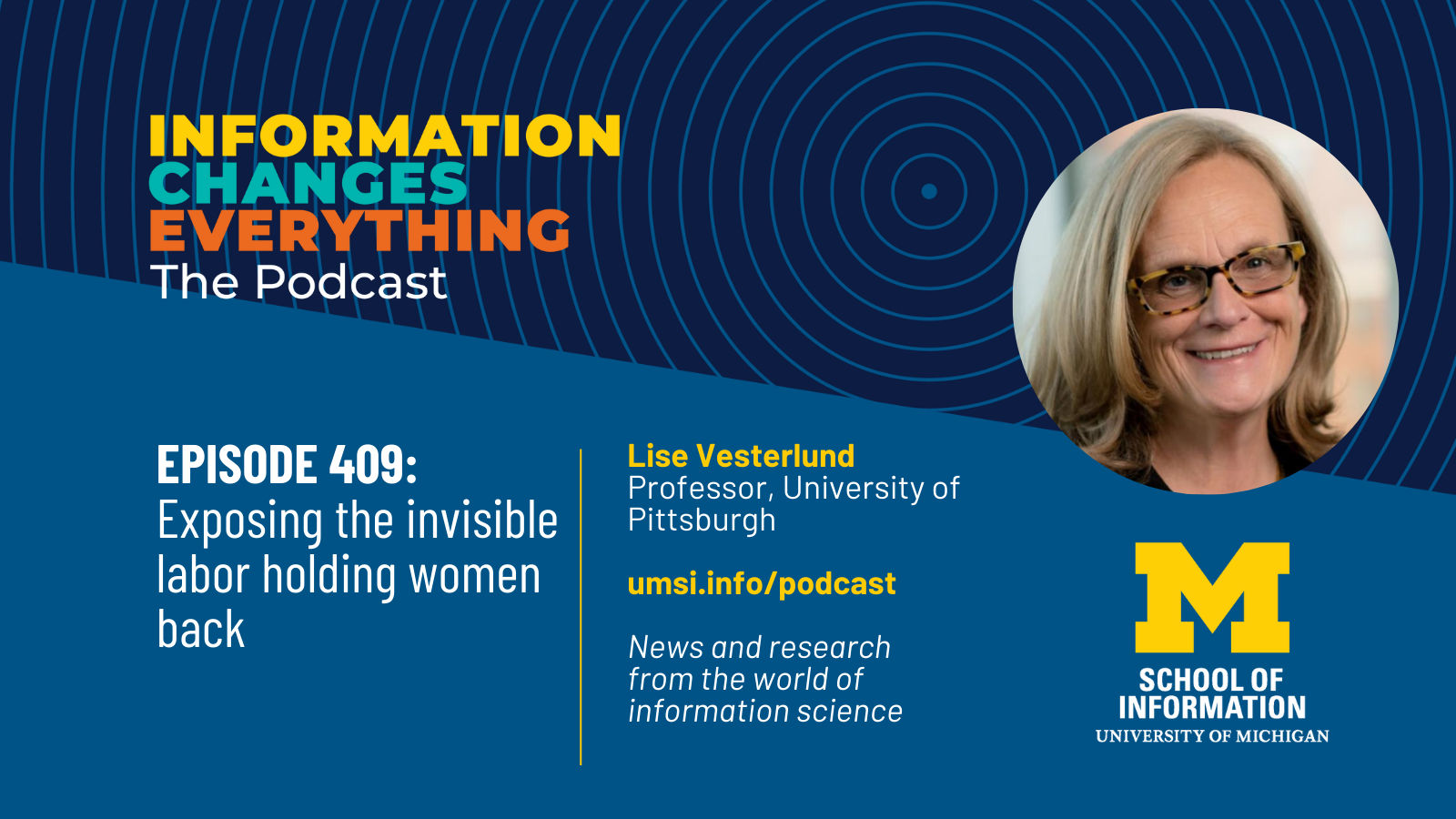
409: Lise Vesterlund exposes the invisible labor holding women back
Listen to UMSI on:
Information Changes Everything
News and research from the world of information science
Presented by the University of Michigan School of Information (UMSI)
Episode
409
Released
July 16, 2024
Recorded
2022
Guests
Lise Vesterlund, Andrew W. Mellon Professor of Economics, University of Pittsburgh, director of the Pittsburgh Experimental Economics Laboratory and the Behavioral Economic Design Initiative, and co-author of “The No Club: Putting a Stop to Women’s Dead-End Work”
Summary
In this episode of “Information Changes Everything,” we hear from economist and professor Lise Vesterlund, who examines why women in the workforce are disproportionately asked to perform “non-promotable work.” This work, often essential yet undervalued, leaves women overcommitted and underutilized in their careers.
Resources and links mentioned
- Full video of Lise Vesterlund’s talk on YouTube
- Faculty Research Highlight: Sile O’Modhrain
- A year of water: Snapshots from UMSI’s first theme year
- Google launches “How Search Works” series to demystify SEO | Search Engine Journal
- umsi.info/events
Reach out to us at [email protected].
Timestamps
Intro (0:00)
Information news from UMSI (1:37)
Hear excerpts from Lise Vesterlund’s 2022 talk “The No Club: Putting a Stop to Women’s Dead-End Work” at UMSI (3:06)
Next time: Jeff Furman on the evolution of Ben & Jerry's social mission (22:21)
Outro (23:17)
Subscribe
Subscribe to “Information Changes Everything” on your favorite podcast platform for more intriguing discussions and expert insights.
About us
The “Information Changes Everything” podcast is a service of the University of Michigan School of Information, leaders and best in research and education for applied data science, information analysis, user experience, data analytics, digital curation, libraries, health informatics and the full field of information science. Visit us at si.umich.edu.
Questions or comments
If you have questions, comments, or topics you'd like us to cover, please reach out to us at [email protected].
Lise Vesterlund (00:00):
Awareness will help us see when this happens. It will help us see when we're in a meeting. We start asking for volunteers to say, wait a minute, this isn't how it should be done. It will help us see when we once again volunteer a female who's overqualified for a job to take notes or set up the next meeting. We'll make everybody else say, nah, this doesn't feel right. So the awareness is the first step.
Kate Atkins, host (00:25):
That was economist and professor Lise Vesterlund during a 2022 talk at UMSI's Social Behavioral and Experimental Economic Seminar series, and this is information Changes Everything where we put the spotlight on news and research from the world of information science. You're going to hear from experts, students, researchers, and other people making a real difference. As always, we're presented by the University of Michigan School of Information UMSI for short, learn more about us at si.umich.edu. I'm your host, Kate Atkins. Today we'll hear more from Lise Vesterlund as she discusses why women in the workforce are disproportionately asked and expected to do non-promotable work, which leaves them overcommitted and underutilized. Vesterlund is the Andrew W. Mellon professor of the Department of Economics at the University of Pittsburgh and the director of the Pittsburgh Experimental Economics Laboratory and the Behavioral Economic Design Initiative. She also co-authored the book, “The No Club: Putting a Stop to Women's Dead-End Work,” which was listed as a top business book by the Financial Times.
(01:37):
Before we jump in, a few other people and projects that you should know about. ||| First, UMSI associate professor Sile O’Modhrain published a new paper examining teaching strategies tailored for blind individuals learning data science and visualization from blind instructors. O'Modhrain research explores topics of accessibility and computing sound and touch, as well as techniques for students exploring the science of motion capture. ||| Next: UMSI's 2023-2024 inaugural theme year focused on water conservation and access students, faculty and staff tackled issues like aging infrastructure, water contamination and invasive species in the Great Lakes. Highlights included redesigning an information system for invasive species, a keynote by Lieutenant Governor Garlin Gilchrist II and a hackathon addressing rain garden data. ||| Finally, for the curious, Search Engine Journal found a five-part video series with Google engineer Gary Illyes explaining how search works aimed at marketers. The videos cover SEO concepts like crawling, indexing and ethical optimization, but the most surprising revelation is that one of the most searched entries on Google is well Google. For more on all of these stories, check out si.umich.edu or click the link in our show notes. Now back to Lise Vesterlund.
Lise Vesterlund (03:10):
So the talk I'm going to give today is focused on a lot of the resources that we have in this new book called The No Club, and I just want to give you a little bit of background on how this whole project came about. The book is joined with Linda Babcock and Brenda Peyser and Laurie Weingart, and about 12 years ago we are all in Pittsburgh. The rest of them are at Carnegie Mellon, but about 12 years ago, we all found ourself in the exact same position where we were working really, really hard and not really being satisfied with where our careers were. So had endless to-do lists that we're working on all the time. I was really good at working late at night and also early in the morning and it really had gotten to the point where it was too much. So we decided to form what we called the no club, and initially we spent a lot of time joking about how we had a no club, no meeting.
(04:07):
It was like lots of spins around the No Club, but really the whole process that led to this book and to the research that led up to it was us meeting together at a embarrassing local bar, drinking $10 bottles of wine and talking about the things that we were working on and why we were so busy and why we felt like we didn't have enough time to focus on the things that really mattered for our careers. As we talked more and more, what we realized was that we were all busy with a certain set of tasks and when we have spent a lot of time thinking about how women advance in the workplace and have come up with lots of different theories for why they struggle to advance, what sort of the introspection of being on the No club led me to think about is that what really matters is how we spend every single day in the office rather than just thinking about what helps us get promoted or the negotiations that gets us the promotion or the salary increase every single day show up in the office and how we distribute that day could very well contribute to these very persistent gender differences we're seeing between men and women in particular.
(05:18):
There was one set of tasks that really were leading us astray and it's what we characterize as being non-promotable tasks. There are tasks that help out your organization but they don't help out your career. Now, you may sort of wonder, well, what are these NPTs? Well, first of all, they vary by occupation. They vary by where you are in your career. There are things that are promotable when you first start out in your job and then they stop being promotable when you sort of advance further down the line. The interesting thing is that they sort of show up all over the place. There was a recent report done by McKinsey and Lean In where they talked to over 400 different organizations and they said, think about some of these jobs and the extent to which this is important for employees in the organization.
(06:05):
And one of the tasks that they looked at was checking in on employee wellbeing, and by that they meant figuring out if the employee had enough time to do their work, figuring out whether or not they're doing okay. And 90% of these organizations said yes, being concerned about employee wellbeing is really critical for a good manager. For our organizations we want leaders who are checking in on employee wellbeing. So they all thought this was important, but then they got a second question which was, do you have any formal recognition of this work? Forget about rewards, but do you have any recognition, any accounting of checking in on employee wellbeing? And it turned out that only 25% of the organizations even recognized this work. The same thing happened when they asked them, what about diversity, equity and inclusion? Is that important? 70% of the organization said Yes, diversity, equity and inclusion really matters to our organization.
(07:03):
We want leaders that are engaged in that. Fewer than 25%, however had any form of recognition for this work. So that's exactly the type of work we're talking about when we talk about non-promotable work. It's work that sort of helps the organization move forward, but not work that we recognize when it comes to promotion and advancement. You can also sort of say, well, can we recognize when it's non-promotable and we did for academia, it's pretty easy. Nonetheless, we did a survey of faculty members where we said, imagine that you had an assistant professor who just magically had an additional 50 hours that they could spend. How should they spend those 50 hours to get promoted? Should they work on a research paper, present research toxic conferences, serve on the undergraduate curriculum review committee or be on faculty senate? Where should they spend their time? Now you won't be surprised to see that 92% of people thought that it was really important to do research if you want to get promoted.
(08:00):
The promotable work in academia is to work on research. The question is sort of what were the other 8% thinking? But it's just a sign of what happens when we do surveys. But there was broad agreement that research is the promotable work. Now if you think broadly outside of academia, it might get a little bit more tricky to think about what is promotable and not promotable. And we worked a lot with different organizations and what we've sort of come down to is that there are four characteristics that can help you assess if something is promotable or not. The first is the extent to which it directly improves the organization's objective. So if you are in a for-profit firm, doing revenue generating work is a really good indicator that this is going to be promotable work. If you're doing work that doesn't directly bring in revenue, it's highly likely that it's non-promotable.
(08:52):
Another characteristic is the extent to which your performance on the task is visible. You might do a really, really good job of editing the new report that's coming out, but nobody's going to see that you did the editing or you might be really good at preparing slides, but if you don't give those slides, nobody's going to know that you did it. So the visibility is important. Another thing that's really critical is whether or not the work requires specialized skills. So if you are a surgeon, doing surgery is specialized, it's your promotable assignments. Administrative work is not, you don't have any specialized skills in that. So a lot of the work that’s non-promotable is work that pretty much anybody can do. So like taking notes at a meeting, all you need is a pen and a pulse, right? So looking at the extent to which the work you're occupying yourself with is something that you have specifically trained for should be an indicator on whether or not it's promotable.
(09:46):
Last characteristic is also to say, well, there's some non-promotable work that sort of leads to promotable work. You might take on a committee assignment because it gets you connected to people who can give you a lot of promotable work down the way, or you might take on a committee assignment because it gives you skills or training that allows you to take on promotable work later. The challenge with this last category of courses that they're diminishing returns really, really quickly. So you might step in, have the experience, but then you need to move on. So those are the characteristics of if you want to figure out if something is promotable, ask those four questions of yourself and you should have a good sense of it. Now as we started our No club, we started this club from a personal perspective, but we were all scholars and we wanted to know was it just women who were busy doing non-promotable work or were men busy doing non-promotable work as well?
(10:44):
Everybody's busy all the time, but we wanted to know whether we were busy with different stuff. One of the things that we did was to go to a professional services firm and the benefit of a professional services firm is that they keep meticulous account of the hours that employees are spending. So after we did that, we went to the management and said, these are the different assignments that are here. Which ones are promotable and which one are less so? And we categorized the assignments into being promotable versus non-promotable. And then we took those categories that management gave us and looked at who were doing the non-promotable work. Well, it turned out at this organization, this is for junior women, they have yet to make partner, women were spending 200 more hours per year on non-promotable work than their male colleagues. Their male colleagues were spending 200 more hours on promotable work.
(11:38):
It's not hard to imagine what happens if you're spending a full month every year on work that doesn't get recognized or rewarded. That's what we saw in the professional services firm. Then we began to look at all the other literature that has been done on this, and of course there has been quite a bit of literature, not where they actually look at the quantity of time, but rather where they just say who's spending more? Sometimes it is quantity of time and academia is one field where there's been a lot of studies done and the consistent finding is that indeed female faculty members are spending more time on committees and they're spending more time advising undergraduates. Now, it extends beyond that because if you look at lawyers, the same thing happens. So attorneys are spending more time on pro bono work than— female lawyers spending more time on pro bono work than male lawyers.
(12:28):
If you look at TSA agents, it's like what could possibly be non-promotable for a TSA agent where it turns out that women are spending a lot more time on pat downs than anybody else. So men get to experience the whole circulation around the station for a TSA agent, which means that when it comes to promotion, they've had all the stations to experience, whereas the women are stuck doing pat downs. If you look at supermarket clerks, where do the women end up? They end up sitting at checkout. They don't get to work in any other place in the store, which means when it comes to promotion, they don't get to advance. Same thing happens for engineers. Same thing happens for architects. So in every profession that is looked at this, the result is the same. Women are spending a lot more time on the non-promotable work.
(13:11):
You can say, well, you're just talking about gender. Is there anything else? If we start looking at race, how does that work? Well, it turns out that if you enter the race component, things get much worse. So women are spending more time a non-promotable work across the board. This is just an example for engineers. Women of color are spending even more time on the non-promotable work. Think about academia where we have this notion that the underrepresented minorities somehow should overrepresent on every committee. Of course, that's going to give them an excessive load of non-promotable work. We're seeing all these differences in work assignments and we can sort of say, okay, well should we be concerned about this? We shouldn't necessarily be concerned about this if women are just much better doing the non-promotable work. That's part of what we do in an organization.
(13:58):
We give employees the work that they're best at, and if women are better doing the non-promotable work, then they should be doing the non-promotable work. If women just really enjoy the non-promotable work, then they should be doing it as well. So we can't just look at different assistant task assignments. Admittedly, the organization we talked to where it turned out that women were spending 200 more hours, a non-promotable work, the organization immediately made changes. So it's not, they weren't intending for their female employees to spend 200 more hours, but in order to sort of give recommendations, we need to understand what gives rise to these assignment differences. To sort of give a sense of that, we thought, well, how are these non-promotable tasks often assigned? And sometimes you're asked to do them. Other times we have this weird process where we ask for volunteers and we wait for somebody to say, I'll do it.
(14:50):
And everybody said, oh, great. She took it. She must be really happy to. So we wanted to look at how do we volunteer for these assignments. We got data from a public university with over 3000 faculty members, and they fortunately had data on faculty senate and volunteering for faculty senate, which was, remember one of the assignments that we saw was non-promotable according to faculty members when they're assessing this work. So serving on faculty senate is important for the university. It doesn't help you get promoted. The faculty senate had sent out this request to all the faculty members to say, can you please sign up and volunteer for faculty senate? Now if you're wondering why not, this is a very attractive task, let me tell you it's not because only 3.7% of the faculty members said, yes, please sign me up. Now, the disturbing part is not just that this wasn't something everybody wanted to do, but rather this is a school that has many more male faculty members than females, but the signup rate for men was 2.6%.
(15:56):
And since there are fewer females, the signup rates for women were much higher than they were for men. What we see instead is that women are vastly overrepresented on faculty senate. And I think what's most disturbing is that if we look at assistant professors who should be most concerned about getting promoted, they account for 38% of the overall faculty. But when I look at the assistant professors and faculty senate, they account for 60%. That means that women are doing two and a half times more than the men. Okay? So the burden on women even at this stage is high. Now, of course, the challenge with looking at data like this, we don't know why women are signing up for faculty senate. Maybe they just really enjoy spending time with their colleagues late at night rather than writing research papers and being with their families. It's a possibility we don't know.
(16:50):
So I don't think that's a likely explanation, but this is the reason why it's hard to look at observational data. So instead, what we decided to do was to run a series of experiments to try to understand what is it that get women to this point where they volunteer more. We often talk about women being more altruistic than men. So it could just be that women are more altruistic and that's why they come into this group and they're like, we should just find a volunteer. We're all going to be happier. Or it could be other preferences. It could be that women are more risk averse, that that's why they end up volunteering more. So in order to look at that, we considered what we had done first, which was that we had equal shares of men and women come into our lab and participate in the experiment.
(17:34):
And we said, well, one way to see if women have different preferences than men, if that's why this is happening, is to run the experiment so that only men show up at the lab, and I'm going to compare that to what happens if only women show up to a lab. So if the altruistic preferences are stronger in the female population, I should see higher volunteer rates in the all female group than in the all male group. Turns out, no, that's not what happens though. It's not consistent with this being driven by preferences. Rather, it is consistent with us playing a simple coordination game where we're trying to figure out who's going to volunteer. And we've played these coordination games many times before where when it's an undesirable task, we're used to expecting women to take this on. And women similarly have internalized that expectation. So they know that if they don't take it on, it's not going to get done.
(18:30):
Once I remove the women from the group, men now know that it's in their interest to step up. So what we're basically finding is this sort of very vicious circle where women volunteer 48% more. They are asked 44% more, and when they're asked, they say yes, 50% more. So across the board, we get women taking on these assignments and being asked to take them on. Let's try to think a little bit about what the costs are of women doing all this work. From the individual perspective, it's clear that if you're doing non-promotable work, you're not going to get promoted. That should be obvious, but do non-promotable work also spills over to the compensation that you get and to your ability to negotiate. And what it also spills over to, and this is one of the areas where we're seeing greater and greater gender differences, is in terms of burnout.
(19:22):
The gender gap in burnout has always been there, but it has doubled during the pandemic. If you talk to a lot of these women who graduate from engineering school, they're excited to come out and be engineers. One of the main reasons why they choose to drop out is that they don't feel like they're doing the job that they were trained to. They feel like they're given these very gendered assignments. Now, we've talked about all these individual costs. You could imagine that it's not so great for the organization either, and why is it bad for the organization? Well, we know that we want to assign work according to comparative advantages, not according to who's least reluctant to take it on. So while I may think that the woman is really good at handling that time consuming client, if you use that talent on a less time consuming client, she may be really, really productive.
(20:09):
Another problem of course, is that we get this culture where nobody's pitching in. It's not ideal for an organization where everybody's trying to shirk on the work that keeps the wheels going in the organization. And of course, we get this misalignment between corporate and individual incentives in this setup. So there's a lot of organizational costs to doing this, and certainly one of the big organizational costs is that we failed to identify the talent in the organization. So if I bring in a bunch of young women and young men and I send the women off to do the non-promotable work, then I can never identify how good they are doing the promotable work. So for the organization, this is really not in their interest. So as I said before, because this is driven by expectations, we really think that the organization is the one that has to make these changes.
(20:57):
It's very hard for individuals to make these changes because while you may be able to say no, you're going to keep getting requests. And importantly, what we found ourself was that when we started saying no, was that the work that we said no to would just be passed on to another woman. So it really is an organizational issue. As much as we have advice in the book about how to think about the work that we take on and be more strategic, this really comes down to fixing the organizations that we're in, because unless we do that, we're going to keep getting asked and the work that you say no to will just be sent to somebody else. So the things to do in the organization, the first step is to bring awareness. So awareness will help us see when this happens. It will help us see when we're in a meeting, we start asking for volunteers to say, wait a minute, this isn't how it should be done. It will help us see when we once again volunteer a female who's overqualified for a job to take notes or set up the next meeting, we'll make everybody else say, nah, this doesn't feel right. So the awareness is the first step. So because of that, I've been really excited to talk about this. We wrote this book to really get the word out, and I appreciate you all coming to listen to this.
Kate Atkins, host (22:11):
You can watch the full talk by clicking the link in our show notes. To learn more about upcoming events like this, visit us at umsi.info/events. And tune in next time to hear from Jeff Furman, chair of the board of Ben & Jerry's Ice Cream during his 2014 talk sponsored by UMSI.
Jeff Furman (22:30):
In 1977, both of us left the school. Ben and Jerry wanted to open up an ice cream parlor in Vermont because I had a degree in business, they thought I would be their business advisor. And just as a friend, they asked me to help him write a business plan. And so actually to write the business plan, since I had never done one, I got hold of a business plan for a pizza parlor, and the three of us sat around the table, whiting out the word pizza and putting in ice cream. Number of slices became number of cones and ovens became freezers, and this was the start of the whole adventure.
Kate Atkins, host (23:15):
That's in our next episode. Before we go, did you know that the University of Michigan offers three different master's degrees in information science? And you can start with an undergraduate degree in almost any field? See the possibilities on our website si.umich.edu. The University of Michigan School of Information creates and shares knowledge so that people like you will use information with technology to build a better world. Don't forget to subscribe to Information changes everything on your favorite podcast platform, and if you've got questions, comments, or episode ideas, send us an email at [email protected]. From all of us at the University of Michigan School of Information, thanks for listening.